


Page 165 - clra62_0019-(GIPE)
P. 165
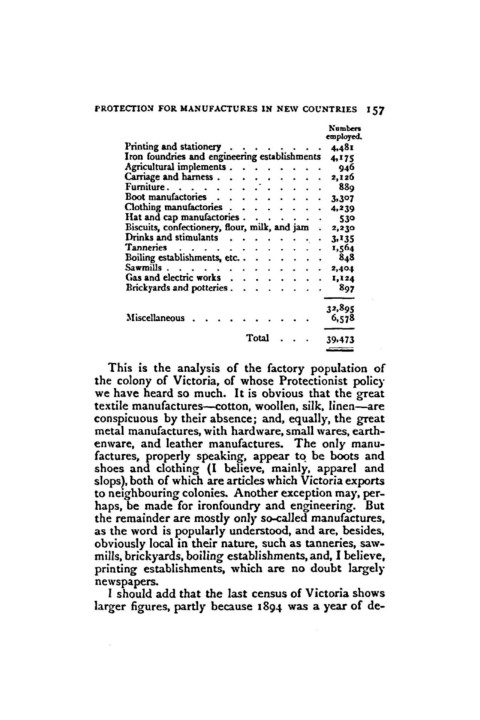
PROTEcrIO~ FOR MANUFACTURES  IN  NEW  COUNTRIES  157
                                                            Numbers
                                                            employed.
                       Printing and stationery  .  .  .  .  .  .  .  .  4.481
                       Iron foundries and engineering establishments  4.175
                       Agricultural implements.               946
                       Carriage and harness.  .              2,126
                        Furniture.  .  .  .  .  .             889
                        Boot manufactories  .  .             3,307
                       Oothing manufactories  .  .           4,239
                        Hat and cap manufactories.  .  .  .  ..   530
                        Biscuits, confectionery, flour,  milk, and jam   2,230
                        Drinks and stimulants  .  .          3,135
                       Tanneries  .  .  •  .  .  .           1,564
                        Boiling establishments, etc. .        848
                       Sawmills.  .  •  .  .  .              2,404
                        Gas and electric works  .            1,124
                        Brickyards and potteries.             897
                                                            3 2 ,895
                        Miscellaneous  .  .  .  .            6,578

                                             Total          39,473

                    This  is  the  analysis  of the  factory  population  of
                  the  colony of Victoria, of whose  Protectionist  policy
                  we have heard so  much.  It is  obvious  that the great
                  textile manufactures-cotton, woollen, silk, linen-are
                  conspicuous  by their absence;  and, equally, the great
                  metal manufactures, with hardware, small wares, earth-
                  enware,  and leather  manufactures.  The only  manu-
                  factures,  properly  speaking,  appear  tQ  be  boots  and
                  shoes  and  clothing  (I  believe,  mainly,  apparel  and
                  slops), both of which are articles which Victoria exports
                  to neIghbouring colonies.  Another exception may, per-
                  haps, be made for  ironfoundry and  engineering.  But
                  the remainder are mostly only so-called manufactures,
                  as the word  is popularly understood, and are, besides,
                  obviously local in their nature, such as tanneries, saw-
                  miUs. brickyards, boiling establishments, and. I believe,
                  printing  establishments.  which are  no  doubt  largely
                  newspapers.
                    I should add that the last census of V ictoria shows
                  larger figures, partly because 1894  was  a year of de-

