


Page 160 - clra62_0019-(GIPE)
P. 160
15 2       ECONOMIC  INQUIRIES  AND  STUDIES
                  sources,  we  shall  find  that  these  manufactures,  if all
                  done  at  home, would  not  employ more  than  the pro-
                  portion stated of the population, viz.,  5 to 7! per cent.
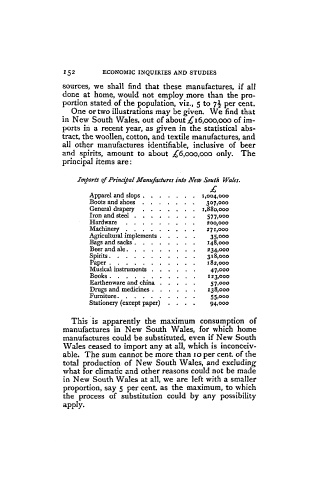
                    One or two illustrations may be given.  We find  that
                  in New South Wales, out ofabout£16,00Q,000 of im-
                  ports in  a  recent year, as given in  the statistical  abs-
                  tract, the woollen, cotton, and textile manufactures, and
                  all  other  manufactures  identifiable,  inclusive  of  beer
                  and  spirits,  amount  to  about  £6,000.000  only.  The
                  principal items are:

                      Imports of Principal Manufactures into New Soutll  Wales.
                                                          :£
                         Apparel and slops  .           1,004,000
                         Boots and shoes                 30 7,000
                         General drapery  .             1,880,000
                         Iron and steel  .  .            577,000
                         Hardware                        200,000
                         Machinery  .  .  .  .  .        27 1,000
                         Agricultural implements  .       35,000
                         Bags and sacks.  .              148,000
                         Beer and ale.  .  .             234,000
                         Spirits.  .  .  .  .            3 18,000
                         Paper.  .  .  .  .              182,000
                         Musical instruments              47,000
                         Books.  .  .  .  .  .           123,000
                         Earthenware and china            57,000
                         Drugs and medicines  .          138,000
                         Furniture.  .  .  .  .  .        55,000
                         Stationery (except paper)        94,000

                    This  is  apparently  the  maximum  consumption  of
                  manufactures  in  New  South  Wales,  for  which  home
                  manufactures could be substituted, even if New South
                  Wales ceased to import any at all, which is  inconceiv-
                  able.  The sum cannot be more than 10 per cent. of the
                  total  production  of New South Wales,  and excluding
                  what for climatic and other reasons could not be made
                  in New South Wales at all, we  are  left with a smaller
                  proportion, say 5  per cent. as  the  maximum, to which
                  the  process  of  substitution  could  by  any  possibility
                  apply.

