


Page 166 - clra62_0019-(GIPE)
P. 166
158        ECONOMIC  INQUIRIES  AND  STUDIES
                  pression compared with  1891, but also in part, accord-
                  ing to  the  explanation  in  the Year  Book, because  in
                  the  census  every individual blacksmith, or carpenter,
                  or harness maker is put down as engaged in manufac-
                  ture.  The factory population, however, is all included
                  in  the  above  figures,  which  show  quite  plainly  that
                  Victoria,  being  a  new  country  with  a  Protectionist
                  tariff,  has  not  acquired  the variety  of manufacturing
                  industry  which  the  tariff,  according  to  the  academic
                  arguments for  Protection, was designed to give it.
                     New South Wal~s has  not  been  steadily a  Protec-
                  tionist country,  and is  not  now  Protectionist;  but,  as
                  far  as  manufactures  are  concerned, it  is  in much  the
                  same economic condition as we  should expect it to be
                  if the thesis here supported is true.  According to Mr.
                  Coghlan's book on "The Wealth and Progress of New
                  South Wales" (p.  539), the hands employed in factories
                  in  1894  numbered  42,751,  out  of a  total  population
                  much the same as that of Victoria, viz., about 1,200,000.
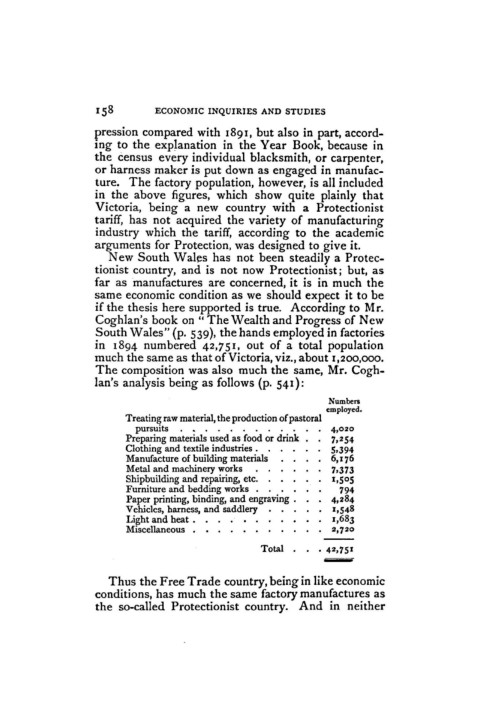
                  The composition was also  much the  same, Mr.  Cogh-
                  lan's analysis being as follows (p.  54 I):

                                                            Numbers
                                                            employed.
                        Treating raw material, the production of pastoral
                         pursuits  .  •  .  .  .  .  •  .  .  .   4,020
                        Preparing materials used as food or drink   7,254
                        Clothing and textile industries.  .   5,394
                        Manufacture of building materials    6,176
                        Metal and machinery works            7,373
                        Shipbuilding and repairing, etc.  .   1,5 0 5
                        Furniture and bedding works  .  .  .  •   794
                        Paper printing, binding, and engraving  .   4,284
                        Vehicles, harness, and saddlery      1,548
                        Light and heat •                     1,683
                        Miscellaneous  •  •  .  .  •
                                                Total     • 42,751


                    Thus the Free Trade country, being in like economic
                  conditions, has much the same factory manufactures as
                  the  so-called  Protectionist  country.  And  in  neither

