


Page 359 - clra62_0019-(GIPE)
P. 359
THE IMPORTj.NCE OF GENER.AL  STATISTICAL  IDEAS  35 I

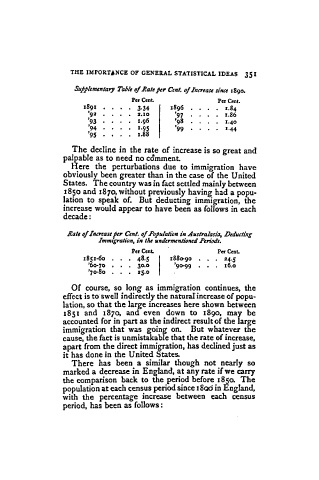
                     Supplementary  Table oj Rate pe, Cent. oj I'lcrease lince  18 90.
                                     Per Cent.              Per Cent.
                        1891          3·34     1896           1.84
                         '93  .       2.10      '97           1.86
                         '9 2
                                                '98
                                      1.96
                                                              1·40
                         '94          1·95      '99           1·44
                         '95          1.88
                    The decline  in  the rate  of increase is so great and
                  palpable as to need no comment.
                    Here  the  perturbations  due  to  immigration  have
                  obviously been greater than in the case of the United
                  States.  The country was in fact settled mainly between
                  1850 and 1870, without previously having had a popu-
                  lation  to  speak  of.  But  deducting  immigration,  the
                  increase would appear to have been as follows  in each
                  decade:

                   Rat, oj IncreaSlpe, Cent. oj PopUlation in Australasia, .Deaucting
                            Immigration, in tlu unaermentionea Periods.
                                     Per Cent.              Per Cent.
                        1851-60     •  4 .5                •  24·S
                                       8
                         '60-70  •   •  3 •                .  16.0
                                       0 0
                         '70-80     •  25. 0
                    or  course,  so  long  as  immigration  continues,  the
                  effect is to swell indirectly the natural increase of popu-
                  lation, so that the large increases here shown between
                  1851  and  1870,  and  even  down  to  1890,  may  be
                  accounted for in part as the indirect result of the large
                  immigration  that  was  going  on.  But  whatever  the
                  cause, the fact is unmistakable that the rate of increase,
                  apart from the direct immigration, has declined just as
                  it has done in the United States.
                    There  has  been  a  similar  though  not  nearly  so
                  marked a  decrease in England, at any rate if we carry
                  the comparison  back  to  the period before 1850.  The
                  population at each census period since 1800 in England,
                  with  the  percentage  increase  between  each  census
                  period, has been as follows:

