


Page 362 - clra62_0019-(GIPE)
P. 362
354       ECONOMIC  INQUIRIES  AND  STUI¥ES
                     Thus, while the excess rate was as high as  2 I  to  28
                   per  J ,000 before  1860, it has  since fallen  to  one of 13
                   only, or about one-half.  Whatever validity may attach
                   to the  method  of calculation, the  real  facts would  no
                   doubt show  a  change in the direction of the table-a
                  decline· in  the  rate of the excess of births over deaths
                   from period  to  period.  The decline in  the  growth  of
                  population  is  thus  not  merely  the  direct  effect  of a
                  change in immigration, but is' connected with the birth
                  and  death-rates  themselves, although  these rates  are
                  of course indirectly affected by the amount and propor-
                  tion  of immigration.  It would  be  most  important  to
                  know  what  the  decline  in  the birth-rate  is  by  itself,
                  and  how  far  its  effects  on  the  growth  of population
                  have been  mitigated  or  intensified  by changes in  the
                  death-rate j  but  United  States  records  generally  give
                  no help on this head.
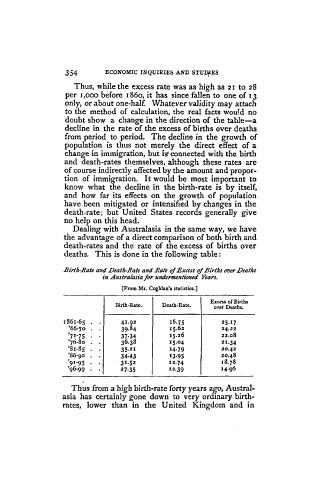
                     Dealing with Australasia  in  the same way, we have
                  the advantage of a direct comparison of both birth and
                  death-rates and  the  rate  of the excess  of births over
                  deaths.  This is done in the following table:

                  Birth-Rate anri .Death-Rate and Rate of Excess of Birtlzs over .Deatks
                             in Australasia for unriermentioneri  Years.
                                  [From Mr. Coghlan's statistics.]
                                                          Excess of Births
                                Birth-Rate.   Death-Rate.
                                                           over Deaths.
                  1861-65         41.92        16·75         25.17
                    '66-70        39. 8 4      15.62         24. 22
                   '7 1 -75       37·34        15.26         22.08
                   '76-80         36,38        15.04         21·34
                   '81-85         35. 21       14·79         20.42
                   '86-90         34·43        13-95         20.48
                   '9 1 -95       31.5 2       12·74         18.78
                   '96-99         27·35        12·39         14'9 6

                    Thus from a high birth-rate forty years ago, Austral-
                  asia  has  certainly gone  down  to  very ordinary birth-
                  rates,  lower  than  in  the  United  Kingdom  and  in

