


Page 363 - clra62_0019-(GIPE)
P. 363
THE  IMPORlANCE OF GENERAL STATISTICAL  IDEAS  355
                   continental ~ount.ries, and Australasia certainly has had
                   heavy  declines  In  the  rate  of  excess  of  births over
                   de~ths~ viz., from  25.17 in. 1861-65, tc;>  1~ in  1896-99,
                   whl~h IS to be compared With the decline In the United
                   States,  as  above  stated  approximately,  from  28  in
                   1820-3°,  and  21  as  late  as  1860,  to  13  in  the  last
                   twenty years.
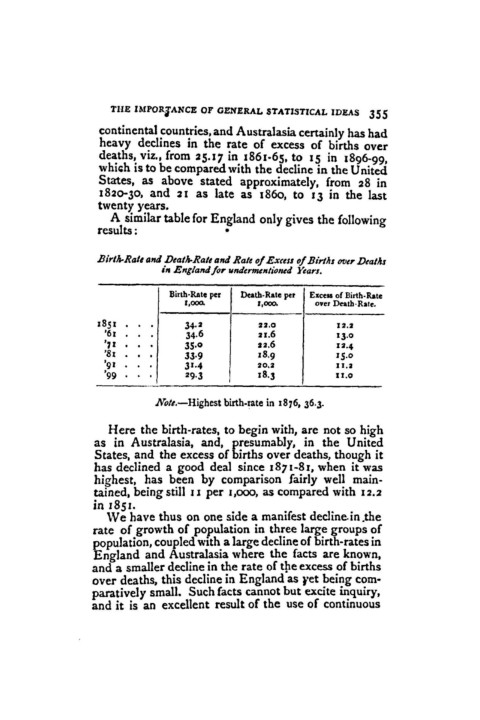
                     A similar table for England only gives the following
                   results:               •

                   Birln.Rall and Dealn.Rall and Rale of Excess of Births OfJe, Dealhs
                              in England for unaermelllionea  Yea,s.

                                Birth-Rate per   Death-Rate per   Excess of Birth-Rate
                                  l,ooa.       I,ooa.     oYer Death-Rare_
                   18 5 1         34. 2         22.0          12.2
                    '71  .         34. 6        21.6          13.0
                    '61
                    '81  . . .    35. 0         18·9          12·4
                                                22.6
                                  33·9
                                                              15.0
                    '91           3 1.4         20.2          11.2
                    '99           29·3          18·3          11.0
                             NOII.-Highest birth-rate in  1876,36,3.

                     Here the birth-rates, to begin with, are not so high
                  as  in  Australasia,  and,  presumably,  in  the  United
                  States, and  the excess of births over deaths, though it
                  has declined  a  good  deal  since 1871-81, when  it was
                  highest,  has  been  by  comparison  fairly  well  main-
                  tained. being still  I I  per 1,000, as compared with  12.2
                  in 1851.
                    We have thus on one side a manifest declinein.the
                  rate  of growth of population in  three large groups of
                  population, coupled With a large decline of birth-rates in
                  England and Australasia where  the  facts  are known.
                  and a smaller decline in the rate of tlte excess of births
                  over deaths, this decline in England as J"et being com·
                  paratively small.  Such facts cannot but excite inquiry,
                  and it  is  an  excellent  result of the  use of continuous

