


Page 36 - clra62_0019-(GIPE)
P. 36
30         ECONOMIC  INQUIRIES  AND  STUDIES
                  1,400,000 square miles of territory in the West, of which
                  only a tithe will ever be available for cultivation, it will
                  be seen that the wholly unoccupied portion of the avail-
                  able  territory  must  now  be  reduced  to  very  small
                  dimensions.
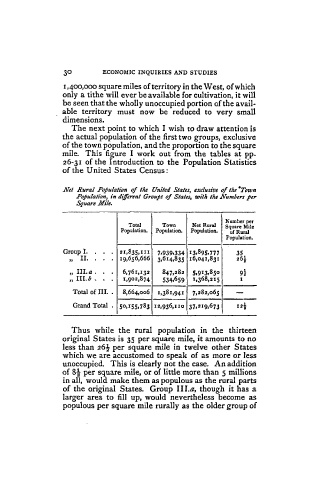
                    The next point to which  I  wish  to draw attention is
                  the actual population of the first two groups, exclusive
                  of the town population, and the proportion to the square
                  mile.  This  figure  I  work  out from  the  tables  at pp.
                  26-31  of the Introduction to  the  Population Statistics
                  of the United States Census:


                  Net  Rural Population  of the  United  States,  exclusive  of the -Town
                      Population,  in different Groups of States,  with the Numbers per
                      Square Mile.

                                                              Number per
                                    Total    Town    Net Rural   Square Mile
                                  Population.   Population.   Population.   of Rural
                                                              Population.
                  Group I.       21,835,111  7,939,334  13,895,777   35
                       II.       19,656,666  3, 61 4,835  16,041,831   26l
                    "
                    "  III. a  .  .  6,761,132   847,282   5.9 1 3,850   9}
                    "  III. b  •   1,902,874   534,659   1,368,21 5   1
                     Total of III.  .   8,664,006  1,381,941  7,282.065   -  -
                     Grand Total  .  50,155,7 83  12,936,110  37, 21 9,673   ut


                    Thus  while  the  rural  population  in  the  thirteen
                  original States is  35  per square mile, it amounts to no
                  less than  26t per square mile  in  twelve  other  States
                  which we are accustomed to speak  of as  more or less
                  unoccupied.  This is clearly not the case.  An addition
                  of 8! per square mile, or of little more than 5 millions
                  in all,  would make them as populous as the rural parts
                  of the original  States.  Group  II I. a,  though  it has  a
                  larger  area  to  fill  up.  would  nevertheless  become  as
                  populous per square mile rurally as the older group of

