


Page 304 - clra62_0019-(GIPE)
P. 304
296       ECONOMIC  INQUIRIES AND STUDIES
                  there are no doubt large additional savings and invest-
                   ments going on at the same time.
                     We come finally to the question of the expendiyne
                   upon armaments in  time  of peace,  which are the,sub-
                  ject of those  re~arks by American  and  other  critics
                  referred to at the beginning of this paper, to the effect
                  that European nations are at a disadvantage, economic-
                  ally, as compared with America, in consequence of these
                  peace armaments.  What has  been  said  as  to  the ex-
                  penditure  in  time  of war  itself, and the  possibility of
                  capital  accumulating  notwithstanding,  obviously  sug-
                  gests that, perhaps, the  nature and effects of expendi-
                  ture upon armaments in peace time have not been fully
                  considered by some of the economists and statisticians
                  who have made such remarks.  But we may look at the
                  facts  directly.  To  take  four  of  the  great  European
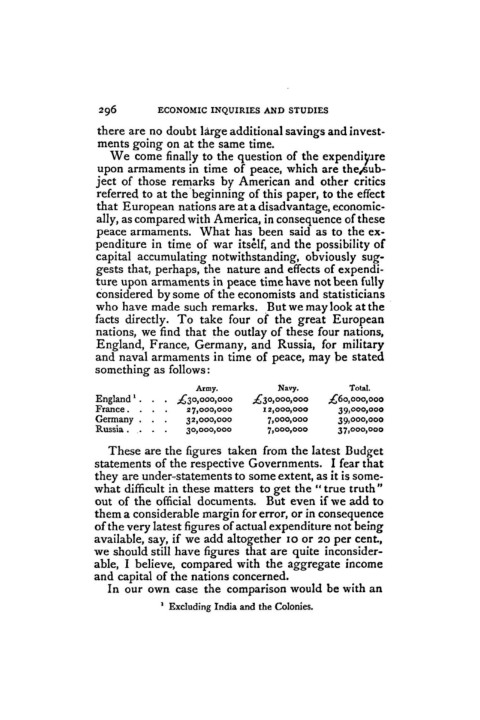
                  nations,  we find  that  the outlay of these four nations,
                  England,  France,  Germany,  and  Russia,  for  military
                  and naval armaments in time  of peace, may be stated
                  something as follows:
                                    Army.          Navy.        Total.
                  England 1.     £30 ,000,000   £30 ,000,000   £60,000,000
                  France.          27,000,000   12,000,000    39,000,000
                  Germany.        3 2 ,000,000   7,000,000    39,000,000
                  Russia.         3 0 ,000,000   7,000,000    37,000,000
                    These are the figures  taken  from  the latest Budget
                  statements of the respective Governments.  I fear that
                  they are under~statements to some extent, as it is some-
                  what difficult in these matters  to get the" true truth"
                  out  of the official  documents.  But even if we add to
                  them a considerable margin for error, or in consequence
                  of the very latest figures of actual expenditure not being
                  available, say, if we add altogether  10 or 20 per cent.,
                  we should still have figures  that are  quite  inconsider-
                  able,  I  believe,  compared with  the aggregate  income
                  and capital of the nations concerned.
                    In our own  case  the  comparison would be with an
                              I  Excluding India and the Colonies.

