


Page 141 - clra62_0019-(GIPE)
P. 141
134       ECONOMIC  INQUIRIES  AND  STUDIES
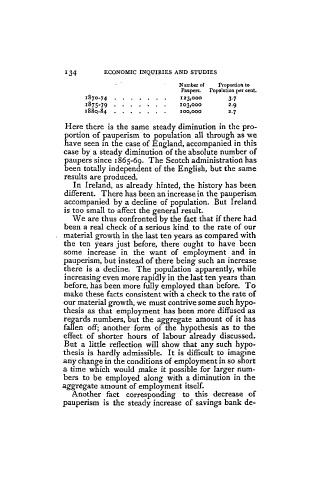
                                                 Number of   Proportion to
                                                  Paupers.   PopulatIOn per cent.
                        18 70'74                  123,000      3-7
                        18 75-79                  103,000      2·9
                        188q.84                   100,000      2·7

                   Here there  is  the same  steady diminution  in the pro-
                  portion of pauperism  to population  all through as we
                  have seen in the case of England, accompanied in this
                  case by a steady diminution of the absolute number of
                  paupers since 1865-69.  The Scotch administration has
                  been totally independent of the English, but the same
                  results are produced.
                     In  Ireland,  as already  hinted, the history has been
                  different.  There has been an increase in the pauperism
                  accompanied  by a decline  of population.  But  Ireland
                  is too small to affect the general result.
                     We are thus confronted by the fact that if there had
                  been a real check of a serious kind  to  the  rate of our
                  material growth in the last ten years as compared with
                  the  ten  years  just before,  there  ought  to  have  been
                  some  increase  in  the  want  of  employment  and  in
                  pauperism, but instead of there being such an increase
                  there  is  a  decline.  The population  apparently, while
                  increasing even more rapidly in the last ten years than
                  before, has been more fully employed than before.  To
                  make these facts consistent with a check to the rate of
                  our material growth, we must contrive some such hypo-
                  thesis  as  that  employment  has been more diffused as
                  regards numbers, but the aggregate  amount  of it has
                  fallen  off;  another  form  of the  hypothesis  as  to  the
                  effect  of shorter  hours  of  labour  already  discussed.
                  But  a  little  reflection  will  show  that  any such  hypo-
                  thesis  is  hardly admissible.  It is  difficult  to  imagine
                  any change in the conditions of employment in so short
                  a  time  which  would  make  it possible for  larger num-
                  bers  to be  employed  along  with  a diminution  in  the
                  aggregate amount of employment itself.
                    Another  fact  corresponding  to  this  decrease  of
                  pauperism  is  the  steady increase  of savings bank de-

