


Page 140 - clra62_0019-(GIPE)
P. 140
RECENT  RATE  OF  MATERIAL  PROGRESS  IN  ENGLAND  133
                  eitherof the previous decades when the rate of material
                  growth  seemed  so  much  greater.  If there  had  been
                  such  real  diminution  in  the rate  of material growth,
                  ought  there  not  to  have  been  some  increase  in  the
                  want of employment and in pauperism to correspond?
                    It  is  one  of the  most  notorious  facts  of the case,
                  however, that there has been no increase, but instead
                  a  very  steady  decrease  of pauperism,  excepting  in
                  Ireland, which is so small  as not to  affect the general
                  result.  As  regards  England,  the  figures  are  very
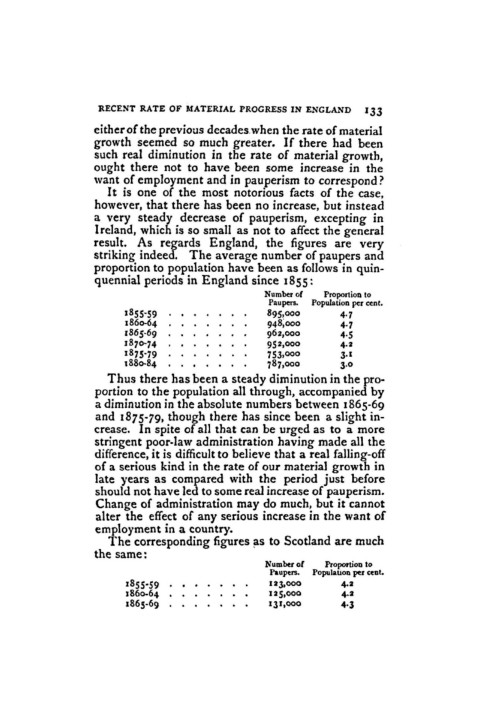
                  striking indeed.  The average number of paupers and
                  proportion to population have been as follows  in quin-
                  quennial periods in England since 1855:
                                                 Number of   Proportion to
                                                 Paupers.   Population per cent.
                       18 55-59                  895,000      4.7
                       1860-64                   948;000      4.7
                       186 5- 69                 962,000      4·5
                       18 70-74                  952,000      4.2
                       18 75-79                  753,000      3.1
                       1880-84                   787,000      3.0
                    Thus there has been a steady diminution in the pro-
                  portion to the population all through, accompanied by
                  a diminution in the absolute numbers between 1865-69
                  and  1875-79, though there has since been  a slight in-
                  crease.  In spite of all that can be urged as  to  a  more
                  stringent poor-law administration having made all the
                  difference, it is difficult to believe that a real falling-off
                  of a serious kind in the rate of our material  growth in
                  late  years  as  compared  with  the  period  just  before
                  should not have led to some real increase of pauperism.
                  Change of administration may do much, but it cannot
                  alter the  effect  of any serious increase in the want of
                  employment in a country.
                    The corresponding figures ?os  to Scotland are much
                  the same:
                                                 Number of   Proportion to
                                                  Paupers.   Population ~r cent.
                        18SS'59                  123,000      4·2
                        1860.64                  125,000      4. 2
                        1865- 69                 131,000      4·3

