


Page 147 - clra62_0019-(GIPE)
P. 147
RECENT  RATE  OF  MATERIAL  PROGRESS  IN ENGLAND  139
                   to  confirm  this observation  as  to  the  special  growth
                   of miscellaneous  industries, but  the  discussion of the
                   figures  would  require  more  preparation  than  I  have
                   had time for, and perhaps more space than can well be
                   spared.
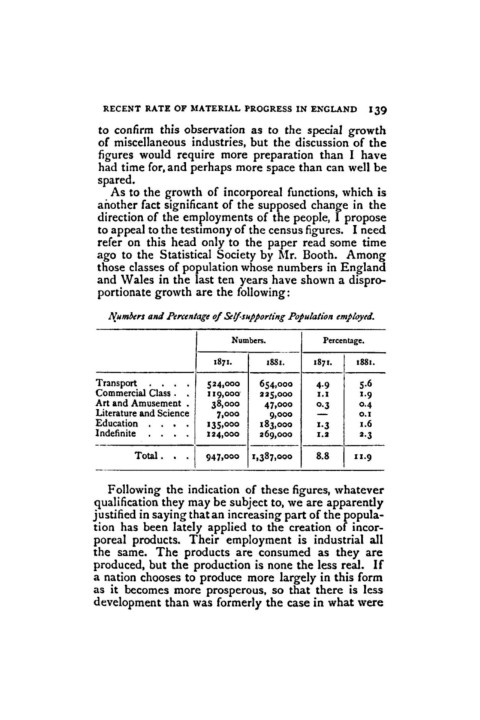
                     As to the growth  of incorporeal  functions,  which is
                  another fact significant of the supposed change  in  the
                   direction of the employments of the people,  I propose
                   to appeal to the testimony of the census figures.  I need
                   refer  on  this  head  only to  the  paper  read some  time
                  ago  to  the  Statistical  Society by Mr.  Booth.  Among
                   those classes of population whose numbers in England
                  and Wales in the  last ten  years have shown a dispro-
                   portionate growth are the following:

                    ~umbers and PeT(enlage of Selfsupporling Populalion employtd.

                                           Numbers.        Percentage.
                                       1871.     1881.   1871.   1881.
                                                               I
                  Transport  .  .  .   524,000   654,000   4·9    5.6
                  Commercial Class.   119,000'   225,000   1.1    1·9
                  Art and Amusement  .   38,000   47,000   0·3    0·4
                  Literature and Science   7,000   9,000   -      0.1
                  Education           135,000   183,000   1·3     1.6
                  Indefinite          124,000   269,000   1.2     2·3
                         Total.  .  .\   947,000   1,387,000   8.8   11·9


                    Following  the indication  of these figures,  whatever
                  qualification they may be subject to, we are apparently
                  justified in saying that an increasing part of the popula-
                  tion  has  been lately  applied  to the creation of incor-
                  poreal  products.  Their  employment  is  industrial  all
                  the  same.  The  products  are  consumed  as  they  are
                  produced, but the  production is none the less real.  If
                  a nation chooses to produce  more  largely in this form
                  as  it  becomes  more  prosperous,  so  that  there  is  less
                  development than was formerly the case in what were

