


Page 78 - clra62_0019-(GIPE)
P. 78
72        ECONOMIC  INQUIRIES  AND  STUDIES
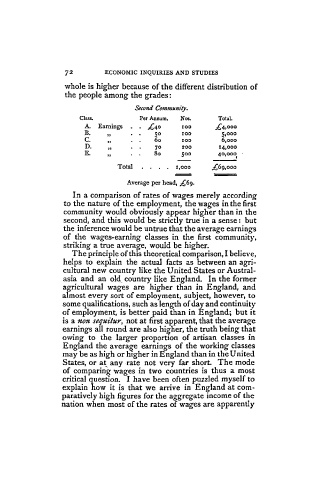
                   whole is higher because of the different distribution of
                   the people among the grades:
                                     Second Community.
                       Class.          Per Annum.   Nos.    Total.
                        A.  Earnings     £40      100      £4,000
                        B.                 50     100        5,000
                        c.    "            60     100        6,000
                        D.    "            7 0    200       14,000
                        E.    "            80      00       4 0 ,000.
                              "                   5
                                 Total           1,000    £69,000
                                                ...........
                                   Average per head,  £69.
                     In a comparison of rates of wages merely according
                  to the nature of the employment, the wages in the first
                  community would obviously appear higher than in  the
                  second, and this would be strictly true in a sense:  but
                  the inference would be untrue that the average earnings
                  of  the  wages-earning  classes  in  the  first  community,
                  striking a true average,  would be higher.
                    The principle of this theoretical comparison, I believe,
                  helps  to  explain  the  actual  facts  as  between an agri-
                  cultural new country like the United States or Austral-
                  asia  and  an  old_ country like England.  In the former
                  agricultural  wages  are  higher  than  in  England,  and
                  almost every sort of employment, subject, however,  to
                  some qualifications, such as length of day and continuity
                  of employment, is better paid than in England;  but it
                  is a  nOlt sequitur,  not at first apparent, that the average
                  earnings all round are also higher, the truth being that
                  owing  to  the  larger  proportion  of artisan  classes  in
                  England the average  earnings  of the working classes
                  may be as high or higher in England than in the United
                  States, or at, any· rate  not  very  far  short.  The mode
                  of comparing wages  in  two  countries  is  thus  a  most
                  critical question.  I  have been often puzzled myself to
                  explain  how  it  is  that we  arrive  in  England at com-
                  paratively high figures for the aggregate income of the
                  nation when most of the rates of wages are apparently

