


Page 110 - clra62_0019-(GIPE)
P. 110
RECENT  RATE  OF  MATERIAL  PROGRESS  IN ENGLAND  103
                   would  otherwise sell;  there is Jess  gross produce, and
                   in proportion there is even less net produce, that is, less
                   rent;  consequently  the  net  income  appearing  in  the
                   Income Tax Schedules is either less than it was or does
                   not  increase  as it did  before.  The same with  mines,
                   with  railways,  and  with  all  sorts  of business  under
                   Schedule D.  The things themselves may increase  as
                   they did before, but as the money values do not increase
                   but diminish, the income tax assessments cannot swell
                   at t1ft!  former  rate.  I t  is  the  same with  salaries  and
                   other incomes not dependent so directly in appearance
                   on the fall in prices.  Salaries and incomes are of course
                   related to a given range of prices of commodities, and
                   a fall in the prices of commodities implies that the range
                   of  salaries  and  incomes  is  itself lower  than  it would
                   otherwise  be,  assuming the real  relation  between  the
                   commodities and incomes to be the same after the fall
                   in  prices as it would  have  been  if there  had  been no
                   fall  in  prices.  Hence the income  tax  assessments by
                   themselves are not a perfectly good test  in  a question
                   like the present.  The change implied may be nominal
                   only, so far as the aggregate wealth  and  prosperity of
                   the community are concerned, though of ,course  there
                   can  be  no great  and  general  fall  of  prices without  a
                 • considerable redistribution of wealth which  must have
                   many important consequences.
                     This criticism, however,  does  not  apply  to  the  re-
                   maining  figures  in  the  short  table  submitted, and  to
                   various  other  well-known  facts,  which  we  shall  now
                   proceed to discuss.
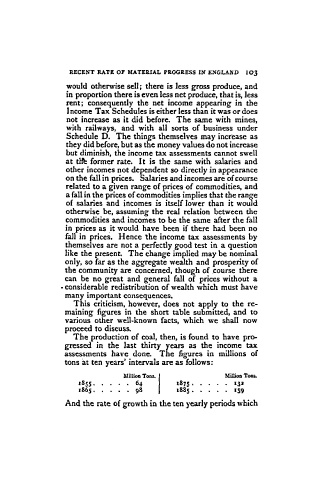
                     The production of coal, then, is found  to have  pro-
                   gressed  in  the  last  thirty  years  as  the  income  tax
                  assessments  have  done.  The  figures  in  millions  of
                   tons at ten years' intervals are as follows:
                                  Million Tons. I

                      1855.  .  .  .  .  64      .875.  •.    Million Toll$.
                                                              .  13 2
                      J865.  •  •  •  •  98      1885.  •.    .  .59
                   And the rate of growth in the ten yearly periods which

