


Page 109 - clra62_0019-(GIPE)
P. 109
102        ECONOMIC  INQUIRIES AND  STUDIES
                  the first twenty years, and since  1875 a much less pro-
                  gress.  The total amount of the assessments themselves,
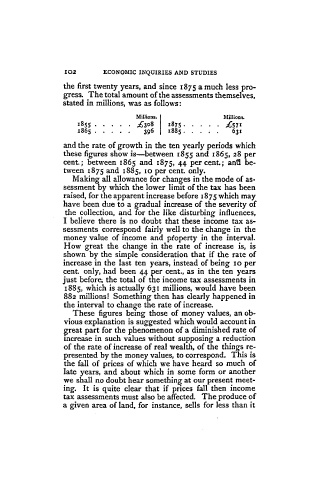
                  stated in millions, was as follows:
                                      Millions. I
                                                             Millions.
                      1855.  .  .  .  .  £308   1875.....  £57 1
                      1865.  .  .  ..   396   1885.....         631
                  and the rate of growth in the ten yearly periods which
                  these figures show is-between 1855 and 1865,  28  per
                  cent.;  between 1865  and  1875,44  per cent.;  anti  be-
                  tween  1875 and 1885,  10 percent. only.
                     Making all allowance for changes in the mode of as-
                  sessment by which the lower limit of the tax has been
                  raised, for the apparent increase before 1875 which may
                  have been due to a  gradual increase of the severity of
                   the  collection,  and for  the like  disturbing  influences,
                  I  believe  there  is  no  doubt  that these  income  tax as-
                  sessments  correspond  fairly well to the change  in  the
                  money value  of income  and  property  in  the  interval.
                  How  great  the  change  in  the  rate  of increase  is,  i!i
                  shown  by the simple consideration  that if the  rate of
                  increase in the  last  ten  years, instead of being  IO per
                  cent.  only, had  been  44 per cent., as  in  the ten  years
                  just before; the total of the income tax assessments in
                  1885, which is actually 631  millions, would  have been
                  882  millions!  Something then has clearly happened in
                  the interval to change the rate of increase.
                     These  figures  being  those  of money values,  an ob-
                  vious explanation is suggested which would account in
                  great part for the phenomenon of a  diminished rate of
                  increase in such values without  supposing a reduction
                  of the rate of increase of real wealth, of the  things re-
                  presented by the money values, to correspond.  This is
                  the fall  of prices of which  we have heard  so much  of
                  late  years,  and about which  in  some form  or another
                  we shall no doubt hear something at our present meet-
                  ing.  It  is  quite  clear  that  if prices  fall  then  income
                  tax assessments must also be affected.  The produce of
                  a given area of land, for  instance, sells  for less  than it

